
“Mister? I do look THAT old already?”
“… Yes.”
“Damn. Okay, what’s going on?”
“Well, I just had a question…”
Collaboration
It’s pretty common to collaborate with people outside your specific area of design. While I did a lot of combat/game mechanic design work, quest designers would often ask me for thoughts and advice on how to do steps of their questlines – or like Afrasiabi, just ask me to implement combat sections for them.
A lot of this was born as a side-effect of three things:
- I helped the Quest Designers out a lot by making scripts they could re-use or teaching them Lua
- I was the youngest combat designer at the time and worked fast
- I talked to *everybody* – in general, I loved socializing and did it as much as possible
- I even spent a lot of time talking to QA back in 133 until someone told me they felt I was overstepping my bounds by hanging out with them too much. (Still don’t feel that’s true today, but being young and scared, I backed off)
This is a really important factor in any career – you don’t necessarily need to know every developer’s name by heart, but get outside of your team and bubble to meet others. Anyways… Ms. Schneider came up and asked.
The Druid Flightform Questline
 Bri: “How do you feel about class-quests?”
Me: “I LOVE them. I feel like the game is a lot richer for having unique experiences that are memorable and specific to a decision.”
Bri: “Okay, then great, I need your help. Alex gave me permission to make one for the Druid Flight Form epic speed upgrade, but Jeff is really concerned about putting effort into making a questline for just one class.”
Me: “Well… I’m the worst person in the world to persuade Jeff of anything.”
Bri: “Oh, don’t worry, Alex will take care of that. The reason I want your help is because you know most of the classes – in fact, you’re the only one playing a Druid right now – and you work fast.”
Me: “Oh.”
Bri: “Yeah… anyways, I have most of the solo-quest stuff down, but I suck at combat mechanics. Can you cook up a few challenges to test the players?”
Me: “Sure. Let me know what you want…”
Structure
Most class questlines historically followed the following structure, courtesy of Patrick Nagle:
- Quest Discovery
- A LOT of NPCs around the world direct to the starting NPC
- This part is incredibly important, because it ensures that you can find the quest line, no matter *where* you are adventuring.
- Story Framing
- Where you explain why you’re on this questline
- Resource collection
- A time and gold sink to make sure you value what you’re about to get
- Exposition
- Continuation of the story, with plot reveals and narrative
- Solo Testing
- Basic feats of competence to showcase that you understand your class’s mechanics
- Story Climax
- The build-up of your preparation leads to a final showdown
- Group Test
- Grab four friends and complete the final challenge, showing you can use your class unique skills in a group scenario.
This structure was considered important, in that it reflected the need for a diversity of experiences and a mental, emotional, financial and time investment in your character. It’s why it was reflected in the Paladin, Warlock and Druid travel quests.
Storytelling by Doing
In crafting video games, you gain a power that storytelling and movies cannot: The power to make the player experience and interact in the events that are about to unfold. This is why the medium is so alluring and powerful. To hear, to see, to do. Which creates the strongest impression?
This is why Brianna’s questline had you interacting with wildlife and other things like that. Similarly, in re-enacting the events at the three “Raven” stones, we had the player re-experience moments related to the hero whose path they were following.
In the case of the eagle statue, the player avenges a fallen eagle who was swarmed by using their tanking form, long-duration regen abilities and Thorns ability to endure the assault. For the falcon statue, you have to outpace the enemy’s increasing damage – demanding the use of your high dps cat or Moonkin forms. Finally, the Hawk’s statue boss tests your root/crowd control and kiting abilities.
In so doing, the player demonstrates basic understanding of their character and the many skills available to the multi-formed Druid.
The Raven God
Finally, we wanted to end the questline with a party-challenge that would allow the druid to be excellent in any form and also give the party that accompanied the Druid to the encounter a reason to take them inside.
The Sethekk halls we re chosen for two reasons:
- Theme
- There were only two bosses and an extra boss would help the zone
Anzu himself was a fairly simple fight. He would stun all players for 6 seconds sometimes. This would allow the group to benefit from HoT spells the Druid specialized in bringing, while allowing Warrior tanks to continue tanking freely. (At this point in time, Paladin tanks hadn’t reached vogue yet…) Anzu’s Dive added movement to the fight and forced the tank to reposition. Next, Spell Bomb allowed the Druid healer or DPS to dramatically improve the effectiveness of their allies by cleansing off a mana-draining effect that would hurt them.
At 35% and 75% he would go invulnerable and summon flocks of AoE monsters – ideal targets for a Bear tank to handle with Thorns and Demoralizing Roar. Finally, three statues in the room could be activated by an attentive druid casting Rejuvenation upon them. The eagle, reflecting the power it missed out on in life, pulses AoE damage, while the Hawk reduces Anzu’s damage to a reasonable level and Falcon increases the DPS of its allies.
Clever, right? There was also a secret mechanic that doubled the length of any rejuv spells cast upon the statues to make keeping all three active possible, but difficult.
There were more nuances that players discovered as they fought the fight, but those were the mechanics we put in place. It wasn’t supposed to be a terribly difficult fight, as we wanted players with Druid members to *always* want to add Anzu to their dungeon run.
Which is why…
Put a Great Reward
W hen we found out that Roman Kenney was creating a unique boss model for Anzu, and that it was made as a mount, it was only natural we make it an epic, super rare drop for anyone in the party. This cosmetic, brilliant reward gave everyone in the party a motive to do the fight each time they came across it. So successful was this motivation, that players would often recruit druids to do Anzu runs just to get a chance at this mount.
Getting players to work together in the pursuit of cooperation and phat lewts. Isn’t that was MMOs are about? 🙂
Oh yeah, and making new friends or something like that…
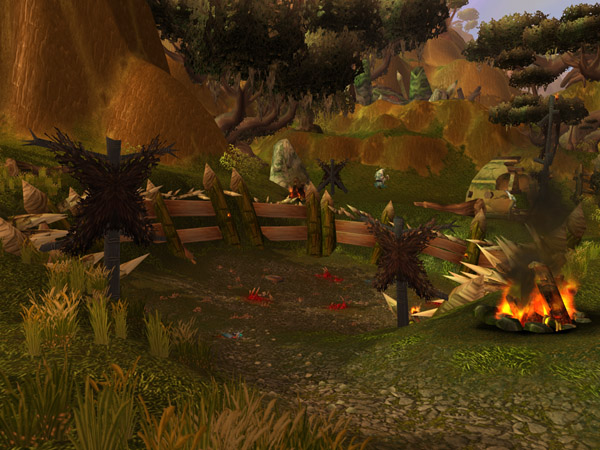
 Yes, Brokentoe. An unepic name for an unepic fight. This encounter was initially part of a five-beast encounter that ended up feeling too similar to Nesingwary’s Expedition capper questlines. However, the spirit of the idea was good, so he stuck around.
 The Blue Brothers, a not-so-subtle reference to the classic 80s movie, were pretty simple. Dual wielding knives, they had Mutilate and Sinister Strike.
 Ah, I loved this model. The Nagrand earth giants were one of my favorite creatures in the expansion. If you’ve been following the Blog series, the fracturing, shattering and creating smaller versions of themselves was a Family ability that Mike and I defined for the elite monsters when we first saw them.
 Ah, this guy. What a friendly clubbing arm he has! What delicious smiles and succulent metal plates. Ahem. This guy was tuned at the difficulty of an actual Dungeon boss. And like any proper dungeon boss, he should scare the living daylights out of you.
 Adding an element of surprise, Mogor, one of the color commentating specators in the ring, heads into the ring to protest your supremacy. Talk about hands-on management!
 Now, anyone who’s worked with Michael knows what it is to get the Heiberg treatment. For those of you not-in-the-know, prepare to be inducted.
 At first, the approach for creating monsters for the Outlands was simple. What do they look like? What should they do? Birds should flap their wings and peck. (Sorry, J.) Mages should cast arcane missiles and fireballs, then so-on.
 Reactive abilities give you the opportunity to respond, by either reducing, negating or otherwise adapting to the situation created by the ability. At it’s most basic, the Mage Fireball is an easy example. If running up to the monster would cause you to aggro too many monsters, hiding behind a wall (… but not a hill, thanks terrain programming) will cause the creature to run around the corner to see you again. If you happen to be a warrior, mage or other class with an interrupt, you can reduce the damage you take with a well-timed Kick to the monster.
 Mike: Are you *sure* you can dodge that spell?